
Walk an East Chicago Street
An address search works best as a chain, not as one query. Ownership is public through Lake County property and deed records, but ownership is not the same as residence. A street directory result becomes more useful when the parcel, map, title record, and time-specific directory agree. Keep a note of the date viewed and the exact spelling entered at each stop.
- Normalize the East Chicago address. Preserve its E or W prefix, number, suffix, unit, and any known older street name. Confirm the delivery form through the USPS address lookup.
- Search Lake County Assessor Engage. Save the parcel ID, situs, owner, mailing address, legal description, and map location.
- Use the parcel map's click, circle, or polygon tool to follow the same side of the street. Open each parcel card rather than assuming the first 25 results cover the full segment.
- Compare the Lake County property-tax search, then follow title instruments through the Recorder by owner and legal description.
- Ask for permit or code files by exact address and date. For past occupants, move to the East Chicago Public Library directories and confirm any criss-cross section in the specific volume.
This street directory process separates what is known from what is inferred. The assessor can name an owner and show a physical parcel. A deed can document a transfer. A printed directory can place a listed subscriber at an address in one year. None of those facts alone identifies everyone who lived there.
East Chicago Address Search Fields
Engage supplies the strongest first anchor for a modern East Chicago street directory. Its basic box accepts an owner, address, or property number. The official user guide says a more specific string is better. Advanced search expands extra criteria, but only one criterion may be used at a time. Map results stop at 25, while Parcel Data can display as many as 75 rows per page.
| Engage control | Input or action | Street-search value |
|---|---|---|
| Owner, Address, Property Number | One text box | Find an anchor parcel by name, situs, or full parcel ID |
| Advanced Search | One expanded criterion | Narrow a broad set without combining unsupported fields |
| Parcel, circle, polygon | Map selection tools | Select one lot or a defined street segment |
| Layer control | Streets, imagery, parcel overlay | Compare the street line with parcel geometry |
| Detail tabs | Summary, transfer, sales, taxes, PRC | Separate current facts from dated transfers and assessments |
The Summary tab can show the owner, legal description, district, township, school corporation, and sketch. Transfer and Sales tabs add dated events. Improvement details may include year built, condition, size, and structure features. Monthly updates apply to most data, while property record cards are updated annually. Always save the displayed data date.
The county tax search shows its address modes here.
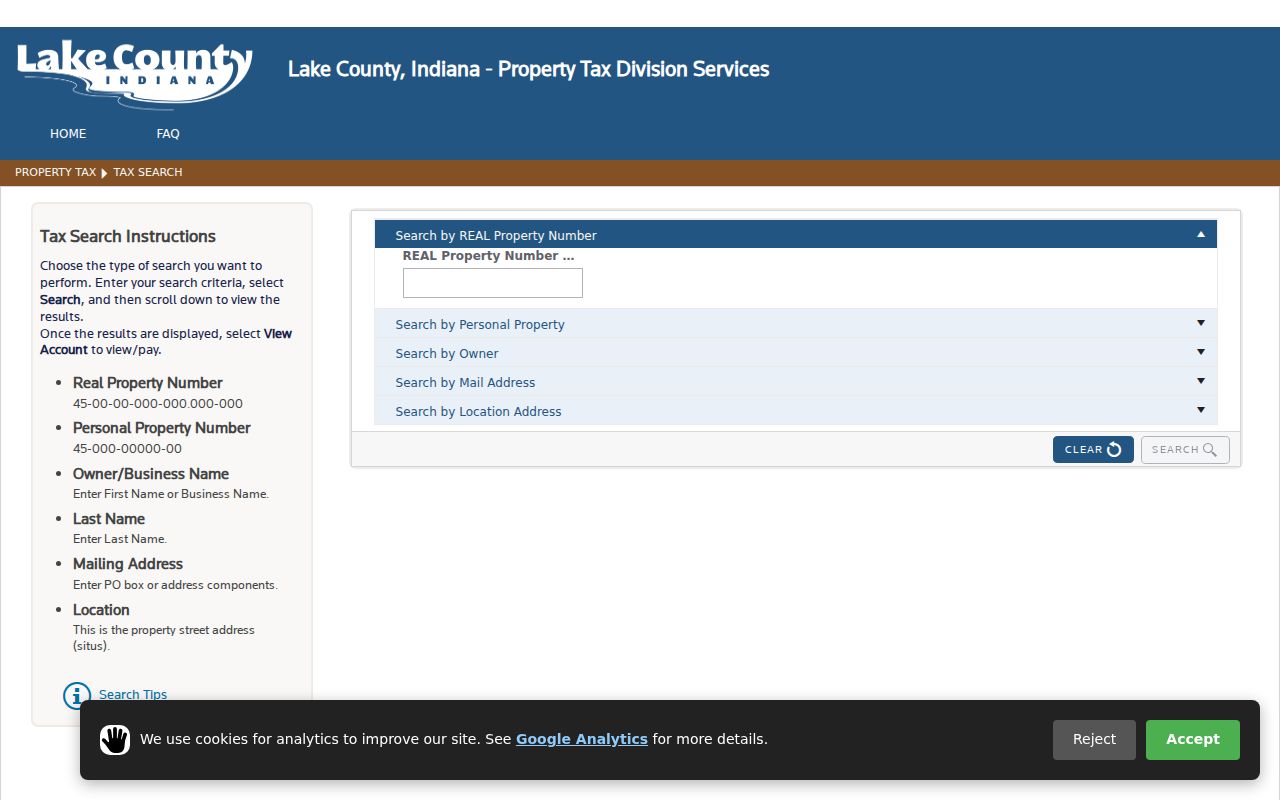
The captured page confirms separate fields for a location, mailing address, owner name, and property number, which helps prevent unlike address facts from being merged.
Define East Chicago Address Terms
Several county terms look interchangeable but are not. Knowing the difference prevents a mailing address from being mistaken for a household and keeps an old deed connected to the right land.
- Parcel
- A legally assessed piece of land identified by a county property number. One street address can involve more than one parcel.
- Situs address
- The physical location of the parcel. It can differ from the address where the owner receives tax mail.
- Plat
- A recorded map showing lots, blocks, streets, and subdivision boundaries. It helps bridge modern addresses and legal descriptions.
- Criss-cross directory
- A directory section arranged by street and house number instead of surname. Its presence must be checked volume by volume.
The observed Lake County parcel format is long and punctuated. Use it whole. County sources do not publish a digit-by-digit public legend, so guessing what each segment means can send the search to the wrong tract.
East Chicago Street Record Layers
No East Chicago record set is a full household roll. Each one answers a narrower question, and several offer a counter, phone, or request route when the web interface stops.
| Address source | Local keeper | Useful result | Access route |
|---|---|---|---|
| Assessor parcel | Lake County Assessor | Owner, situs, mailing, parcel, value, transfers | Free Engage portal or assessor office |
| Tax account | Lake County tax division | Account, owner, mailing address, location | Free property-tax search |
| GIS parcel | Lake County Surveyor/GIS | Boundaries, roads, nearby parcels | Dynamic hub or county map request |
| Recorded instruments | Lake County Recorder | Deeds, mortgages, liens, plats | Account-gated portal, counter, or request |
| Permit and code file | East Chicago Building/Code | Applications, decisions, inspections, notices | Department request or APRA |
| Historical directory | ECPL, State Library, IU CRA | Year-specific occupant, address, phone | Library shelf, archive, or digitized item |
The parcel number and legal description are the most stable joins. Street text connects the city file and printed directory, but old spelling and renamed roads require care. Voter information is more restricted: IndianaVoters validates an individual's registration, while a broader file request uses VRG-24 and county rules. It should not be presented as an open household list.
Map East Chicago By Street
East Chicago streets pass canals, rail property, industrial tracts, alleys, and irregular lots. The Lake County GIS Hub gives county map context, while Engage offers documented single-parcel, circle, polygon, and measure tools. Click each parcel card and record its relationship as same side, across street, contiguous, or merely nearby.
The map is geometry, not proof of who lives there. A hover preview may show parcel number, address, and owner, but the parcel detail remains the field source. When the county hub's dynamic labels are unclear, contact the Surveyor for a map or data request rather than naming a layer that has not been verified.
Lake County's 2008 and 2009 point-address project is an unusually useful clue. It linked the owner's address with the actual parcel address, first for developed single-family property and later for multi-residential, commercial, public, industrial, and utility parcels. That history explains why two address fields can be correct at once.
Deeds Along East Chicago Streets
After the assessor identifies a parcel owner, the Lake County Recorder supplies the title layer. Search the current owner as grantee, read the purchase instrument, preserve its legal description and recording reference, then search the seller as grantee in the prior transaction. Grantor means the party conveying an interest; grantee means the party receiving it.
The Recorder advertises more than three million documents and recordings more than 200 years old. Yet its online search redirects to an account login, and no public cutoff year or post-login field list was verified. The responsible street directory method treats that limit as part of the route. Call 219-755-3730 or visit the Crown Point counter for older books, microfilm, or staff help. Online document purchases are listed at $1 per page plus a $3 order charge.
Do not treat every recorded item as a sale. A mortgage, release, lien, easement, plat, correction, or estate instrument can affect the parcel without transferring full ownership.
East Chicago Files By Address
Permit and code records add the work history of a property. East Chicago's Building Department keeps applications, issued or rejected permits, inspections, and official work records under city code section 33.019. The permit page is under construction, so no public address index is available. Code Enforcement likewise has no public case search.
The city publishes the current permit access page.
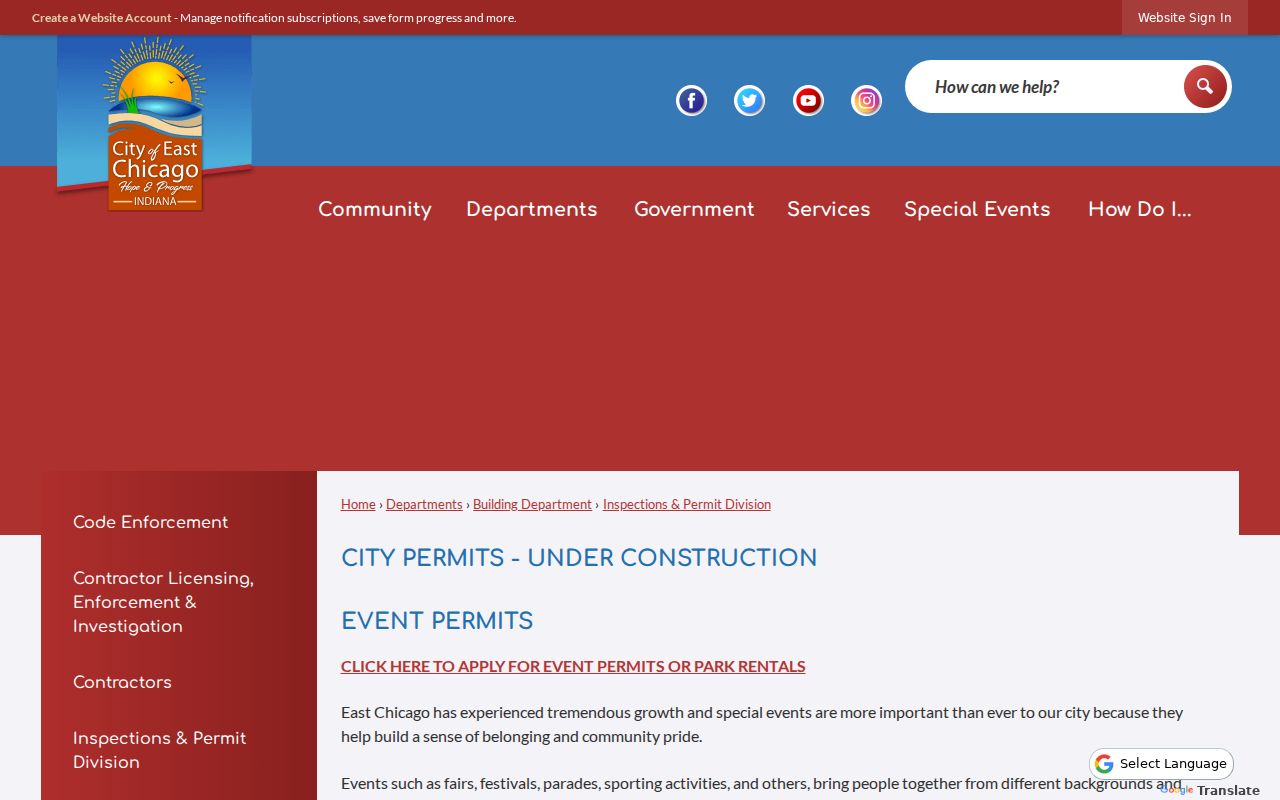
The image confirms why an offline request is needed. Give Building or Code Enforcement the exact address, parcel, record type, and date range. A particularized East Chicago APRA request can seek inspection or copies; the form lists a standard-page fee of $0.20.
Code Enforcement describes the records it creates here.
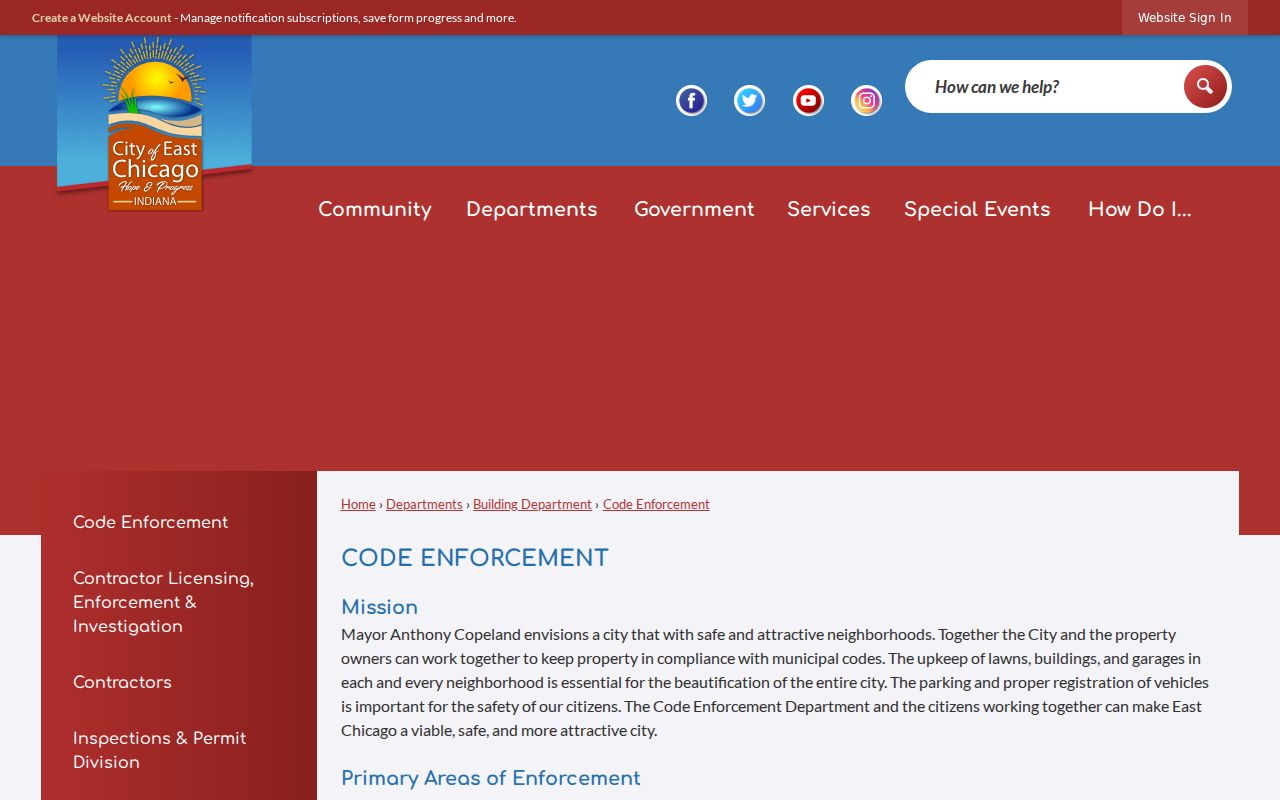
The department covers unsafe structures and property, electrical, and plumbing issues, but the screenshot is not a case result or an occupant list.
East Chicago Street Names Change
Forsyth Avenue became Indianapolis Boulevard in 1933. The IU Calumet Regional Archives finding aid explains that the change helped reduce confusion for traffic headed toward the Chicago World's Fair. Search both names in deeds, maps, newspapers, and directories when an address predates the change.
The city also grew as a Twin City. Western East Chicago and Indiana Harbor were divided by rail and industrial geography, then linked by a Columbus Drive overpass in the early 1930s. Old sources may abbreviate the same area as E Chgo or Ind Hbr. Preserve that original label before adding a modern place name.
Directional prefixes matter across the numbered grid. East and West Chicago Avenue, Columbus Drive, and numbered streets are distinct search strings. No complete official citywide renumbering or annexation schedule was found, so a street directory should not invent one.
Historic East Chicago Address Clues
The East Chicago Public Library lists city directories from 1908 through 1958 and local phone books back to 1888. These sources can connect an address to a listed person in a specific year. They do not prove legal title or current status. Confirm whether a volume has a street-order or criss-cross section before relying on it.
The 1922 Illinois Bell Calumet page shows how much local shorthand matters. One entry reads “Brunsdon Bertha A r 4202 Baring. E Chgo-1208-J.” It preserves a name, residence mark, street address, abbreviated locality, and phone exchange. A full account of those collections belongs on the East Chicago city directory page; here, their role is to extend an address search into an earlier year.
Sanborn maps then test street and building continuity. East Chicago runs include 1930 and later update spans through 1948. They show footprints and uses, not resident names.
Limits Of East Chicago Street Records
A parcel owner may live elsewhere. A trust or estate name may hide the individuals involved, and a listed subscriber may have moved soon after publication. Utility customer data and motor-vehicle address records are not open resident rolls. Address Confidentiality Program participants and protected voters can also be withheld by law.
An East Chicago street directory should therefore report the source, record date, and narrow fact actually shown. Missing or redacted data can be lawful and intentional. It is never sound to guess at an unlisted person or use map adjacency as proof of a relationship.
Lawful use. Use East Chicago address records for lawful personal research only. Indiana law prohibits stalking, harassment, threats, and misuse of protected voter information.
When the goal shifts from the whole street to one named person, confirm the identity through a second official source. Similar names and stale mailing addresses can otherwise create a false match.